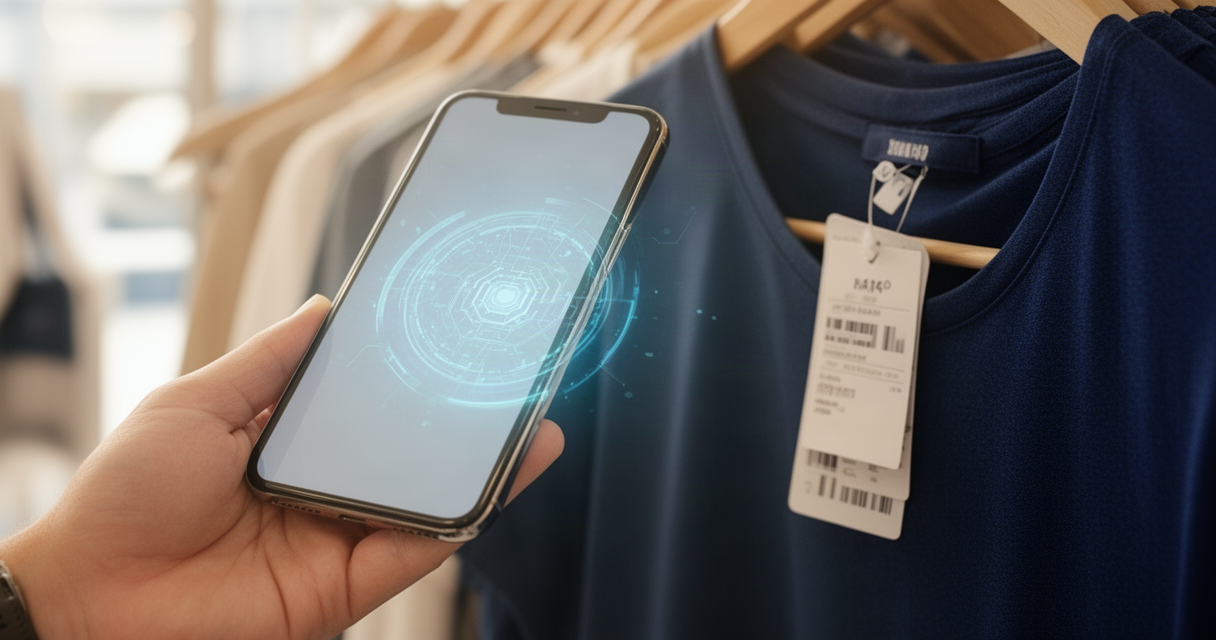
Are AI jewelry identifier apps worth it in 2026? Search “jewelry identifier” on the App Store and the same product appears fifteen times over: same pitch, same promise of an “instant appraisal,” icons close enough to mistake for each other. Point a phone at a ring, get a material, a gemstone guess, and a dollar figure in under ten seconds.
The stakes behind that ten seconds vary wildly. Sorting a deceased parent’s jewelry box means deciding what gets sold, what gets insured, and what gets tossed in a junk drawer — get it wrong and a real diamond goes in the donation pile, or a $4 Claire’s ring gets listed for $200. Thrifters scanning a $10 baggie of costume pieces have less on the line, but the same core question: real or not.
The quick answer: these apps work as a free first-pass sorting filter and nothing more. They cannot test metal purity, cannot verify a gemstone, and their output is not accepted by insurers, buyers, or estate attorneys. What they’re actually good at, and where they fall apart, comes down to what real users on the App Store have reported after paying for them.
What “AI Jewelry Identifier” Apps Actually Claim to Do
The mechanism is consistent across the category: a photo goes in, a computer vision model pattern-matches it against training images, and a guessed material, gemstone type, and value range comes out. No physical measurement happens anywhere in that pipeline.
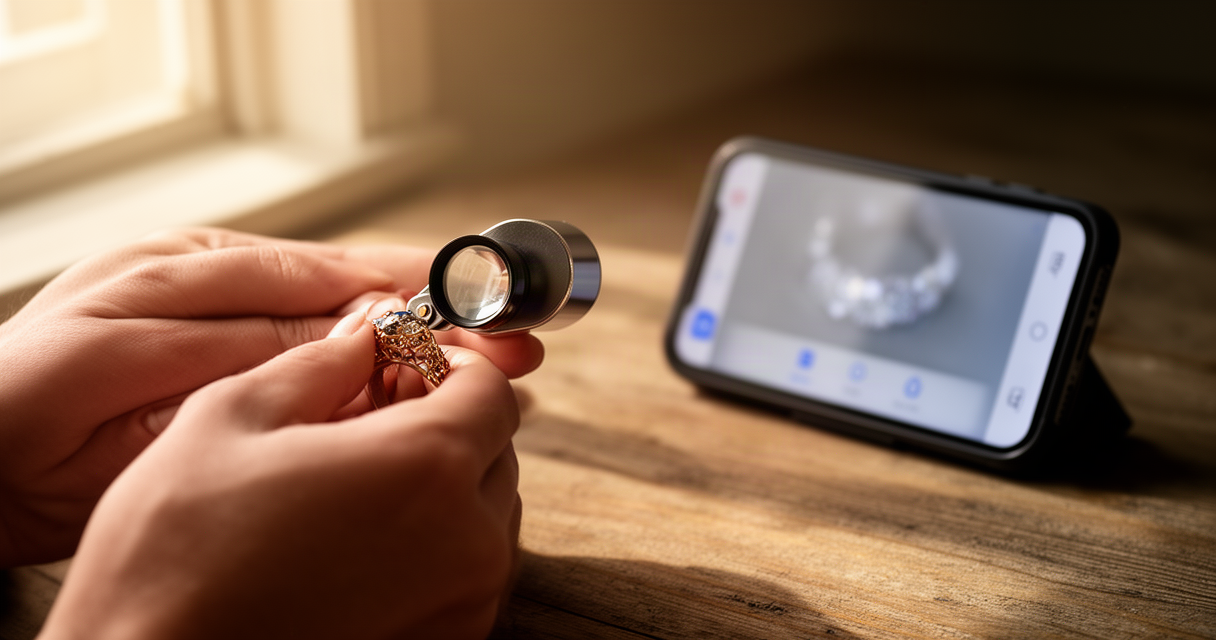
That distinction matters more than the marketing admits. A jeweler determining whether a stone is a diamond runs a thermal conductivity test or checks refractive index with a refractometer. Gold purity gets confirmed with an acid test or an XRF (X-ray fluorescence) machine, not a glance. A loupe reveals inclusions and cut quality a camera sensor will never capture.
Vendor claims of “95%+ accuracy” or “instant appraisal” show up across nearly every listing in this category, and none of them publish the underlying validation data. No accuracy study, no sample size, no methodology — just the number, repeated. A pattern-matching model looking at a photo is structurally incapable of doing what a loupe, a refractometer, an acid test, or a thermal probe does. That’s not a software bug to be patched in the next update. It’s the hard ceiling of what a photo-only tool can ever verify.
The Clone Problem: Why There Are 15+ Nearly Identical Apps
Search the App Store for “jewelry identifier” and the results read like a lineup of siblings: Jewelry Identifier: Appraisal, Jewelio, GemstoneAI, Gem Value, JewelValue, AI Jewelry Identifier & Value, and a long tail of others with names and icons close enough to swap by mistake.
The blog content promoting these apps follows the same pattern. Sites like jewelryidentifier.io, jewelryappraisals.app, and jewelry-identifier-app.com all read like variations on one reused template — same structure, same claims, same “best app for 2026” framing, different logo pasted on top. That’s an App Store Optimization volume play, not a product category built on genuine differentiation.
None of these apps publish independent accuracy testing. None disclose their training data. Picking “the best one” among fifteen near-clones is closer to a coin flip than a research decision, because there’s no public evidence to sort winners from losers.
This isn’t unique to jewelry. AI sneaker authentication apps run into the same trust gap — a crowded field of look-alike apps making similar accuracy claims with similarly thin evidence behind them. The pattern repeats wherever a category lets an AI vision model stand in for a trained human eye and a physical test.
What Real Users Actually Report: Accuracy and Reliability
The App Store review sections for these apps tell a more consistent story than the marketing pages do, and it’s not a flattering one.
One reviewer of Jewelry Identifier - Appraisal described scanning an entire collection: “I have 30 rings that were valued by this app on the low range at $15,000 and top range if diamonds were real at $85,000. Real value turned out to be less than $3000 for all of them and some had real diamonds. Not even close! Don’t use this tool.” The gap there isn’t a rounding error — it’s a 5x to 28x overvaluation on a batch of real pieces.
Consistency is its own problem. A reviewer of Jewelio ran the same ring through the app three separate times: “Took 3 pics of one ring, 3 different times and got 3 different results! Result 1- platinum and diamond ring $5000, Result 2- white gold and diamond ring $16000, Result 3- diamond and sapphire ring $2600… In reality, this ring is white junk metal with cut plastic ‘rhinestones’. $4.00 from Claire’s boutique. This app is a joke!” Three scans, three different materials identified, three different price tags — for a piece that cost four dollars.
Material confusion shows up repeatedly across reviews. Another Jewelio reviewer summarized it in five words: “Nah - Identifies silver as gold.” A reviewer of GemstoneAI: Jewelry Identifier reported a similar gemstone miss: “scanned a green sapphire and it identified it as something else.”
None of this reads as an occasional glitch. It reads as a model that’s confidently wrong on a regular basis, on exactly the two questions — what’s the metal, what’s the stone — that the entire product exists to answer. Useful for narrowing down a pile of forty pieces to the twelve worth a second look. Dangerous for anything where money or insurance actually rides on the answer.
The Pricing Trap: Free Feels Free Until It Doesn’t
The typical funnel across this category runs one to two free scans, then a paywall. Pricing patterns aggregated across listings commonly show a trial that converts to a recurring charge around $4.99 per week — which works out to about $260 per year if it’s never canceled. Annual plans tend to land in the $24.99 to $29.99 range, and lifetime unlocks show up around $59.99.
That subscription cost buys access to a tool that, per the reviews above, gets the material wrong on the pieces that matter most. Reliability complaints extend past accuracy into whether the paid version even functions. A reviewer of Jewelry Identifier - Appraisal described paying for a year and getting a broken app in return: “Work on first two I tried and keeps crashing on the third. Just says ‘Something went wrong, try again’. No where to find any support to see what is wrong. Paid for a year and now I have an app that doesn’t work at all. Don’t waste your money!”
Some reviewers report the premium unlock never activating at all. A Jewelio reviewer described it as a bait and switch: “Free lifetime premium is offered in in-app purchases options, but in app clicking on upgrade to premium doesn’t do anything. Total bait and switch by this fraudulent developer. Do not trust them with your money.”
The practical guidance from this pattern is direct: don’t pay a subscription to sort costume jewelry. The free tier delivers the same triage-level guess the paid tier does — a guess, not a verified result — so there’s no accuracy upgrade being purchased at any price point in this category.
Where These Apps Are Genuinely Useful
The category isn’t worthless. It has a real, narrow use case: triage on a large lot of unknown jewelry, whether inherited or picked up secondhand.
Someone facing forty pieces from a relative’s estate, or a thrift store haul of mixed costume and possibly-real jewelry, has a sorting problem before an appraisal problem. A free scan that sorts pieces into “obviously costume,” “possibly real, worth a closer look,” and “take this to a jeweler” saves time even when the specific dollar figures attached to each guess are unreliable. Beginners also get some value from the vocabulary these apps surface — terms like “clarity,” “hallmark,” and “karat” that make the next conversation with an actual jeweler more productive.
A reviewer of Jewelry Identifier - Appraisal captured both the appeal and the ceiling of the category in one comment: “This is the best jewelry ID app I’ve found. Does a good job if you really have no idea what you have but even so if you can’t identify hallmarks or have a precision scale, you’re not going to get responses you can trust… I’ve found however that a jeweler prompt in Gemini does better customized identification and price estimates for my needs.”
That last line is worth sitting with. A user who tried multiple approaches concluded that a general-purpose AI model with a well-written prompt performed comparably to — or better than — a purpose-built jewelry app charging a subscription. That’s not a strong endorsement of the specialized app category.
Where to Stop Trusting the App
Three situations sit outside what any photo-only tool can responsibly handle, no matter how the marketing reads.
Selling. Buyers, auction houses, and resale platforms don’t accept an app screenshot as proof of value or authenticity. They run their own verification, and an app valuation carries no weight in that process.
Insuring. Insurance companies require a signed, certified appraisal from a qualified gemologist before covering a piece at its claimed value. An AI-generated number, however confident it sounds, isn’t a substitute document.
Estate and inheritance disputes. When jewelry value is contested among heirs, the number needs to come from a neutral, certified third party — someone whose credentials can hold up if the disagreement escalates. An app’s guess resolves nothing in that scenario.
High-value, antique, and handmade pieces are also where these models perform worst, because they’re furthest from the mass-market items the training data likely skews toward. A reviewer of Jewelio described exactly this failure on signed Native American jewelry: “I have scanned several $1000 plus signed Native American pieces. Nowhere to add info for hallmark, weight etc. This is an app that’s good for kids. $250 max valuations! Refund please.” The same accuracy ceiling shows up in how AI authentication apps hold up for luxury resale items: AI verification handles volume and speed well but still can’t fully replace a trained specialist on the pieces where the money is real.
The underlying logic holds across every case above: AI sorts, a gemologist authorizes. A certified appraiser earns the fee precisely because they can run physical tests, sign a document, and stand behind a number in front of an insurer or a courtroom. No app in this category does any of that.
Frequently Asked Questions
Can an AI app tell if a piece is real gold or a genuine gemstone from a photo?
No. Confirming gold purity requires an acid test or an XRF machine, and confirming a gemstone requires tools like a refractometer or a thermal conductivity tester. A camera photo contains none of the physical data those tests measure, so any app output is a visual guess, not a verified result.
How accurate are jewelry identifier apps compared to a certified gemologist or appraiser?
App Store reviews show significant gaps, including one case where a 30-ring collection was valued by an app between $15,000 and $85,000 when the real value was under $3,000. A certified gemologist runs physical tests and issues a signed appraisal that insurers and buyers accept; an app produces an unverified estimate with no accountability behind it.
Which jewelry identifier app is actually useful for thrift or estate finds?
No app in this category has published independent accuracy validation, so there’s no evidence-based way to name a standout. The realistic use for any of them is the same: fast, free triage to separate obvious costume pieces from ones worth a professional look — not a source of a trustworthy price.
Is it safe to trust an AI valuation before selling inherited jewelry?
No. Buyers and auction houses run their own authentication and won’t accept an app-generated value. Anything with potential real worth should go to a certified appraiser before a sale decision, especially given how far off these app valuations have run in real user reports.
Why are there so many nearly identical jewelry identifier apps — is that a red flag?
Yes. Fifteen-plus apps with near-identical names and icons, backed by blog content that reuses the same template across different domains, points to an App Store Optimization strategy rather than genuine product differentiation. None of these apps disclose accuracy testing, which makes picking a “best” one an unfounded exercise.
The Real Verdict on These Apps
These apps earn a narrow role: a free first-pass filter for sorting a big pile of unknown jewelry into “obviously costume,” “maybe real,” and “get this looked at.” They fail — sometimes badly, per the reviews above — the moment metal purity, gemstone authenticity, insurance, or a sale enters the picture.
The practical move is to run the free tier across everything in question, then take only the shortlisted pieces to a certified appraiser for the tests a camera can’t perform. Paying a subscription for a more confident-sounding guess doesn’t change the underlying limitation.
The app can tell you what to look at twice. It can’t tell you what to sign your name to.